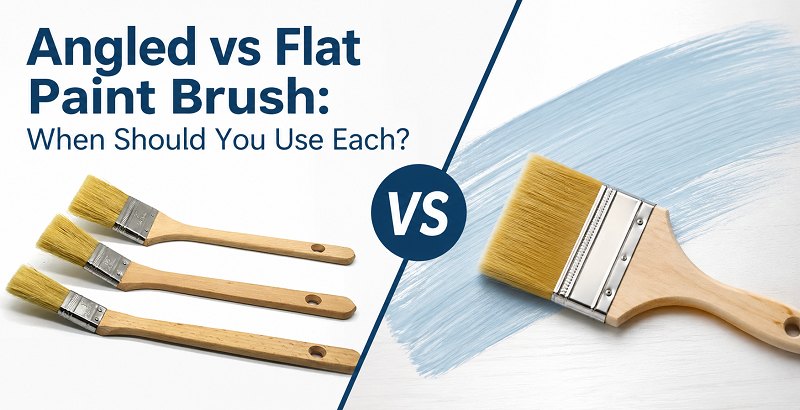
Angled paint brushes are designed for precision work—cutting in edges, painting corners, and handling detailed surfaces with control. Flat paint brushes, on the other hand, are better suited for broad, even coverage on flat surfaces such as doors, panels, and furniture. In professional painting workflows, both are essential tools used in combination to balance accuracy and efficiency.
What Is the Difference Between an Angled and a Flat Paint Brush?
The primary difference lies in the shape of the bristle edge and how it affects paint control:
Angled Paint Brush (Sash Brush)
Features bristles cut at an angle (typically 30–45 degrees), allowing better visibility and precision when working along edges and tight spaces.
Flat Paint Brush
Has a straight bristle edge, designed for smooth, consistent paint application across flat surfaces.
From a manufacturing standpoint, the distinction also involves:
Bristle alignment and trimming accuracy
Filament stiffness and tapering
Epoxy bonding strength for durability
Handle balance for ergonomic control
A reliable paint brush manufacturer ensures these parameters are tightly controlled to deliver consistent performance across large production batches.
When Should You Use an Angled Paint Brush?
1. Cutting In Along Edges
Angled brushes are the preferred tool for painting along ceilings, baseboards, and trim without overlapping onto adjacent surfaces.
2. Corners and Tight Spaces
The slanted bristle design allows better access to corners, reducing the need for masking tape and minimizing rework.
3. Window Frames and Trim
Detailed architectural elements require precise paint placement, which angled brushes handle more effectively than flat brushes.
4. Controlled Line Work
For projects that demand clean lines—such as accent walls—angled brushes provide superior control.
When Should You Use a Flat Paint Brush?
1. Large, Flat Surfaces
Flat brushes distribute paint evenly across doors, cabinets, and flat wooden panels.
2. Smooth Finishes
The straight edge helps create uniform coatings, especially when working with enamels or varnishes.
3. Heavy Paint Application
Flat brushes typically hold more paint, making them suitable for base coats or thicker materials.
4. Industrial and Bulk Applications
In production environments, flat brushes are often used for repetitive coating tasks where precision is less critical than efficiency.
Angled vs Flat Paint Brush: Performance Comparison
| Feature | Angled Paint Brush | Flat Paint Brush |
Precision | Excellent | Moderate |
Coverage Speed | Moderate | High |
Edge Work | Ideal | Limited |
Surface Coverage | Moderate | Excellent |
Control | High | Moderate |
Best Use | Trim, edges, corners | Doors, panels, large areas |
For distributors and contractors sourcing through paint brush wholesale channels, offering both types ensures coverage of all application scenarios.
Is an Angled Brush Better for Cutting In?
Yes. Angled brushes are specifically engineered for cutting in. The sloped bristles provide better line-of-sight and control, allowing painters to follow edges accurately without excessive overlap.
Can You Use a Flat Brush Instead of an Angled Brush?
A flat brush can be used for edge work, but it requires significantly more skill to achieve clean lines. Without the angled tip, maintaining consistent edge definition becomes more difficult, especially for less experienced users.
Do Professionals Prefer Angled or Flat Brushes?
Professional painters use both, depending on the task:
This combination ensures high productivity without compromising finish quality.
How to Choose the Right Paint Brush for Your Project
1. Bristle Material
Synthetic filaments (nylon, polyester): Best for water-based paints
Natural bristles: Ideal for oil-based coatings
2. Brush Size
1–2 inches: Detail work and trim
2–3 inches: General-purpose painting
3–4 inches: Large surface coverage
3. Filament Quality
High-quality brushes feature flagged tips for better paint pickup and smoother release.
4. Manufacturing Consistency
When sourcing from a paint brush supplier, consistency across batches is critical—especially for contractors handling large-scale projects.
What Defines a High-Quality Paint Brush?
Even bristle distribution with minimal shedding
Strong ferrule attachment to prevent loosening
Ergonomic handle design for prolonged use
Chemical resistance to different paint types
A professional paint brush manufacturer will implement strict quality control processes, including bristle retention testing and solvent resistance verification.
Should You Buy Paint Brushes in Bulk?
For distributors, contractors, and retailers, bulk purchasing offers:
Lower per-unit cost
Stable product quality across projects
Custom branding opportunities (OEM/ODM)
Reliable supply chain support
Partnering with a trusted paint brush supplier or sourcing directly from a manufacturer helps optimize both cost and performance.
Common Mistakes When Choosing Between Angled and Flat Brushes
Using flat brushes for detailed trim work → results in uneven edges
Using angled brushes for large surfaces → reduces efficiency
Ignoring bristle compatibility with paint type → affects finish quality
Choosing low-quality brushes → leads to shedding and inconsistent results
How to Achieve a Professional Finish
Use an angled brush to define edges and corners first
Follow with a flat brush (or roller) for larger surfaces
Maintain consistent stroke direction to avoid visible marks
Avoid overloading the brush to prevent drips
This workflow ensures both precision and efficiency across residential and commercial projects.
Conclusion
Angled and flat paint brushes serve distinct but complementary roles. Angled brushes provide the precision required for edges and detailed work, while flat brushes deliver efficient coverage for broader surfaces. Selecting the right tool—and sourcing it from a reliable paint brush manufacturer—directly impacts both application efficiency and final finish quality.
FAQs
What is an angled paint brush used for?
It is primarily used for cutting in, painting edges, corners, and detailed trim work.
Are flat paint brushes better for large surfaces?
Yes, flat brushes provide faster and more even coverage on flat areas.
Which brush is better for beginners?
Flat brushes are easier for general use, while angled brushes require more control but offer better precision.
Do expensive paint brushes make a difference?
Higher-quality brushes typically offer better bristle retention, smoother finishes, and longer lifespan.
Can one brush type replace the other?
Not effectively. Each brush type is optimized for specific tasks, and using both yields the best results.
 English