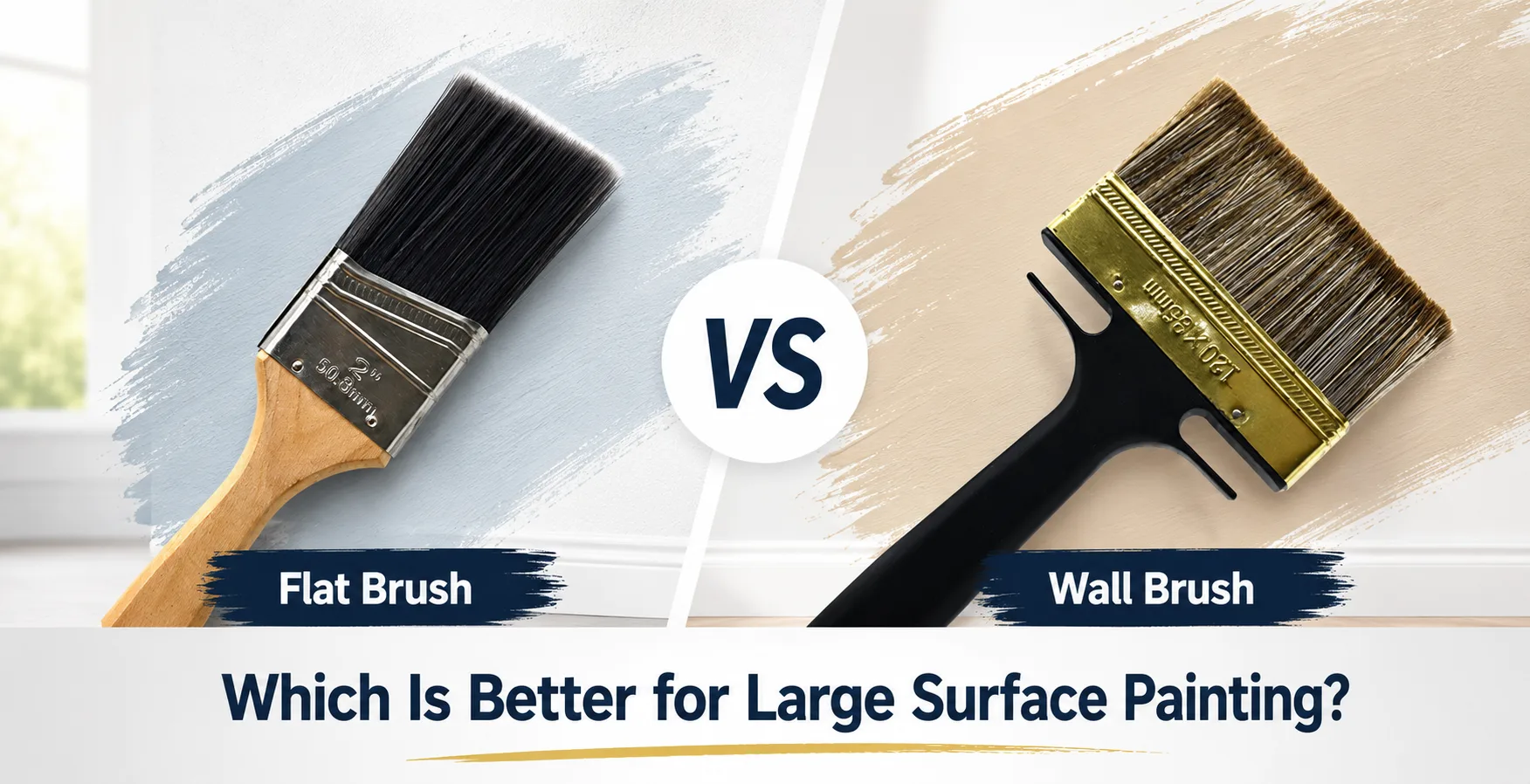
For large surface painting, a Wall Brush is usually better when the surface is wide, rough, porous, or textured. It holds more paint, covers more area per stroke, and can push coating into uneven surfaces more effectively. A Flat Brush is better for smoother flat areas, smaller panels, doors, furniture, fences, and general painting where control and a cleaner stroke pattern are more important than maximum coverage speed.
If you are painting large walls, masonry, exterior surfaces, rough plaster, or textured areas, choose a Wall Brush. If you are painting wooden panels, doors, cabinets, trim boards, or medium-sized flat sections, choose a Flat Brush. In many professional painting projects, both Paint Brush types are used together: the Wall Brush handles broad or rough areas, while the Flat Brush handles controlled finishing and smaller surfaces.
Wall Brush vs Flat Brush: Main Difference
The main difference between a Wall Brush and a Flat Brush is the intended painting area. A Wall Brush is designed for coverage. It is usually wider, thicker, and able to carry more paint. A Flat Brush is designed for controlled, straight, even strokes on flat surfaces.
| Feature | Wall Brush | Flat Brush |
|---|
| Best Use | Large walls, rough surfaces, masonry, exterior painting | Doors, panels, furniture, fences, trim boards, general painting |
| Coverage Speed | High on large surfaces | Moderate on medium flat surfaces |
| Paint Holding Capacity | Usually higher | Moderate to good depending on size and bristle density |
| Finish Control | Better for coverage than fine detail | Better for controlled strokes and cleaner edges |
| Surface Compatibility | Rough, textured, porous, large surfaces | Smooth to moderately textured flat surfaces |
| Typical Buyer | Contractors, exterior painters, masonry coating users | DIY users, decorators, furniture painters, general painters |
What Is a Wall Brush?
A Wall Brush is a larger paint brush designed for wall coating and broad surface application. Compared with a standard Flat Brush, it usually has a wider brush head, thicker bristle filling, and stronger paint loading capacity. This makes it suitable for painting walls, rough plaster, concrete, masonry, brick, fences, exterior surfaces, and other large areas.
Wall brushes are especially useful when a roller cannot reach the surface effectively or when the surface is too rough for smooth roller application. The bristles can push paint into small gaps, pores, and uneven textures, which helps improve coverage on difficult surfaces.
Best Applications for Wall Brushes
Interior and exterior wall painting
Rough plaster and textured wall surfaces
Concrete, brick, block, and masonry surfaces
Exterior fences and large wooden boards
Waterproofing coatings and primers
Large repair areas where rollers are not practical
Edges and corners on rough surfaces
Advantages of Wall Brushes
Higher coverage efficiency: A wider brush head covers more area per stroke.
Better paint loading: Thick bristles can hold more coating and reduce frequent dipping.
Good for rough surfaces: Bristles can work paint into uneven textures better than some rollers.
Useful for exterior work: Suitable for masonry, fences, concrete, and weathered surfaces.
Strong commercial value: Wall Brush products are practical for contractor and renovation markets.
Limitations of Wall Brushes
Not ideal for narrow trim or detailed edges
Can feel heavy when fully loaded with paint
May leave stronger brush marks on smooth surfaces
Requires more control to avoid uneven pressure
Less suitable for fine furniture or cabinet finishing
What Is a Flat Brush?
A Flat Brush is a Paint Brush with a straight bristle edge and a rectangular brush head. It is one of the most common brush types for general painting because it provides controlled, straight strokes and can be used across many flat surfaces.
Flat brushes are available in many sizes, from small 1 inch brushes for touch-ups to wider 3 inch or 4 inch brushes for panels and medium-sized surfaces. They are used in house painting, furniture refinishing, woodwork, door painting, fence coating, and general decorating work.
Best Applications for Flat Brushes
Doors and wooden panels
Cabinets and furniture
Fences, shelves, and boards
Trim boards and baseboards
Medium-sized wall sections
Priming and general surface coating
DIY repair and repainting projects
Advantages of Flat Brushes
Better stroke control: The straight edge helps create even, predictable strokes.
Versatile use: Suitable for many flat surfaces and common painting jobs.
Easy to use: A Flat Brush is simple for beginners and professionals to handle.
Good finish potential: With quality bristles, it can provide a smooth finish on panels and wood.
Strong retail demand: Flat Brush products are easy to sell as everyday painting tools.
Limitations of Flat Brushes
Slower than a Wall Brush on large surfaces
Lower paint capacity compared with many wall brushes
Less effective on rough masonry or deep texture
May require more passes on broad wall areas
Not as efficient as rollers for very large smooth walls
Which Brush Is Better for Large Surface Painting?
A Wall Brush is generally better for large surface painting because it is designed to cover wider areas and carry more paint. This is especially important for rough walls, exterior surfaces, masonry, and large renovation projects where speed and coverage matter.
However, large surface painting does not always mean the same thing. If the surface is a large smooth wall, a roller may be faster than both brush types. If the surface is a large wooden panel, door, or flat board, a Flat Brush may provide better control and a neater finish. If the surface is rough, porous, or uneven, a Wall Brush is usually the better option.
Wall Brush vs Flat Brush by Surface Type
| Surface Type | Better Choice | Reason |
|---|
| Large smooth interior wall | Roller plus Wall Brush for edges | Roller covers faster; Wall Brush helps around corners and rough areas |
| Rough plaster wall | Wall Brush | Thicker bristles can push paint into uneven texture |
| Concrete or brick wall | Wall Brush | Better paint loading and deeper surface penetration |
| Wooden door panel | Flat Brush | Provides controlled strokes and a cleaner panel finish |
| Fence boards | Flat Brush or Wall Brush | Flat Brush for smooth boards; Wall Brush for rough or wide exterior boards |
| Cabinets and furniture | Flat Brush | Better control for smaller surfaces and visible finish areas |
| Exterior masonry coating | Wall Brush | Higher paint capacity and better performance on porous surfaces |
When Should You Choose a Wall Brush?
Choose a Wall Brush for Rough or Textured Surfaces
Rough surfaces need a brush that can carry enough paint and force it into surface irregularities. A Wall Brush is more suitable for concrete, brick, stucco, block walls, rough plaster, and aged exterior walls. A standard Flat Brush may only coat the high points and leave low areas under-covered.
Choose a Wall Brush for Exterior Painting
Exterior painting often involves rougher surfaces, larger areas, and stronger coatings. A Wall Brush can help apply primer, masonry paint, exterior wall paint, and waterproofing coatings more effectively. For contractors, this can reduce repeated passes and improve productivity.
Choose a Wall Brush When Paint Loading Matters
If the surface absorbs paint quickly, a brush with higher paint holding capacity is useful. Wall brushes usually have thicker bristle filling, allowing users to cover more area before reloading. This matters for porous surfaces, large repair zones, and heavy coatings.
Choose a Wall Brush for Corners on Rough Walls
Rollers may struggle to reach corners, edges, and irregular areas on rough walls. A Wall Brush can work paint into these sections more reliably, especially during renovation or exterior repair projects.
When Should You Choose a Flat Brush?
Choose a Flat Brush for Doors, Panels and Boards
A Flat Brush is better when the surface is flat, visible, and requires neat strokes. Doors, cabinets, furniture panels, shelves, and trim boards benefit from the controlled edge and balanced paint release of a quality Flat Brush.
Choose a Flat Brush for Smaller Large Surfaces
Not every “large” surface needs a Wall Brush. A medium-sized wooden board or cabinet side panel may be better painted with a 2 inch or 3 inch Flat Brush because it provides more control and reduces the risk of overloading the surface.
Choose a Flat Brush for Better Finish Control
When finish appearance matters more than coverage speed, a Flat Brush is often preferred. It can help reduce uneven pressure and allows the user to work in smooth, consistent strokes. This is important for furniture, decorative woodwork, and visible interior surfaces.
Choose a Flat Brush for General Retail Use
For DIY customers and home improvement users, Flat Brush products are easy to understand and useful across many projects. They are suitable for touch-ups, furniture, doors, panels, fences, and general painting tasks.
Is a Wall Brush Better Than a Roller?
A Wall Brush is not always better than a roller. For large smooth walls, rollers are usually faster and provide more even coverage with less visible brush texture. However, a Wall Brush is better when the surface is rough, porous, narrow, or difficult to reach.
In professional painting, rollers and Wall Brush products often work together. The roller covers open areas quickly, while the Wall Brush handles edges, corners, rough patches, masonry details, and areas where the roller cannot apply paint properly.
Is a Flat Brush Good for Painting Walls?
A Flat Brush can be used for painting small wall sections, edges, repair areas, and places where a roller is not practical. However, it is not the most efficient choice for full wall painting. For large walls, a roller or Wall Brush is usually more productive.
Flat brushes are better positioned for controlled surface painting rather than broad wall coverage. They are especially useful for doors, panels, trim, fences, furniture, and medium-sized flat surfaces.
Brush Size: How Width Changes Performance
Brush type matters, but brush width also plays a major role. A narrow Flat Brush may be excellent for trim but too slow for large panels. A wide Wall Brush may cover faster but feel heavy and harder to control.
| Brush Size | Recommended Brush Type | Best Use |
|---|
| 1–2 inch | Flat Brush | Trim, touch-ups, furniture details, narrow boards |
| 2.5–3 inch | Flat Brush | Doors, panels, cabinets, fences, medium surfaces |
| 4 inch | Wall Brush or wide Flat Brush | Walls, large boards, rough surfaces, exterior work |
| 5–6 inch | Wall Brush | Large rough walls, masonry, concrete, exterior coating |
Bristle Material: What Should Buyers Check?
Both Wall Brush and Flat Brush products can be made with natural bristles, synthetic filaments, or blended bristles. The right material depends on the paint type and target application.
Synthetic Bristles for Water-Based Paint
Synthetic bristles are usually better for latex paint, acrylic paint, emulsion paint, water-based primer, and modern wall coatings. They resist water absorption and maintain stiffness better during painting.
Natural Bristles for Oil-Based Coatings
Natural bristles are suitable for oil-based paint, varnish, stain, and some solvent-based coatings. They hold and release these coatings smoothly, making them valuable for wood finishing and traditional painting work.
Blended Bristles for Balanced Performance
Blended bristle brushes can provide a balance of paint holding, flexibility, and durability. For commercial buyers, blended options may be useful when targeting professional painters who need reliable performance across different applications.
Quality Factors for Wall Brush and Flat Brush Products
Bristle Density
A quality Paint Brush should have sufficient bristle density. Sparse bristles reduce paint holding capacity and can create uneven strokes. Wall Brush products especially need dense filling because they are used for larger and rougher surfaces.
Ferrule Strength
The ferrule must hold the bristles securely. A weak ferrule can cause bristle shedding, looseness, and short product life. For wide Wall Brush products, ferrule strength is even more important because the brush carries more paint and experiences more pressure.
Handle Comfort
Handle comfort affects productivity and user fatigue. A wide Wall Brush becomes heavier after paint loading, so the handle must provide a stable grip. A Flat Brush used for finishing work should also feel balanced and easy to control.
Bristle Recovery
The bristles should return to shape after pressure. Poor recovery causes streaks, uneven paint release, and reduced control. This matters for both Flat Brush finish quality and Wall Brush coverage consistency.
Paint Release
Good brushes should release paint evenly rather than dumping too much paint at once or leaving dry streaks. Buyers should evaluate paint pickup and release performance during product sampling.
Cost and Long-Term Value Comparison
Flat Brush products are often more economical and have broad everyday demand. They are suitable for general retail sales, DIY projects, and standard decorating work. Wall Brush products may require more material and stronger construction, especially in wider sizes, so they can cost more but provide better productivity for large or rough surfaces.
For professional users, the lowest brush price is not always the best value. A cheap Wall Brush that sheds bristles or loses shape during exterior work can create rework and customer complaints. A cheap Flat Brush used on visible panels can leave marks and reduce finish quality. Long-term value depends on correct product matching and stable manufacturing quality.
Recommended Product Line Strategy for Buyers
For wholesalers, importers, paint tool brands, and hardware retailers, the strongest product line usually includes both Wall Brush and Flat Brush products. This allows customers to choose based on application rather than forcing one brush to handle every job.
Basic Paint Brush Range
1 inch Flat Brush for touch-ups and details
2 inch Flat Brush for general home painting
3 inch Flat Brush for doors, panels, and fences
4 inch Wall Brush for walls and large surfaces
5–6 inch Wall Brush for rough exterior and masonry work
Professional Contractor Range
High-density Wall Brush products for rough walls and exterior coating
Durable synthetic Flat Brush products for water-based paints
Natural bristle Flat Brush options for oil-based coatings and wood finishing
Multiple handle styles for different working preferences
Clear packaging showing surface type, paint type, and recommended use
Common Mistakes When Choosing Between Wall Brush and Flat Brush
Using a Flat Brush for Rough Masonry
A Flat Brush may not carry enough paint or reach deep surface texture efficiently. On rough masonry, brick, and concrete, a Wall Brush is usually more effective.
Using a Wall Brush for Fine Finish Work
A Wall Brush is designed for coverage, not fine finishing. On cabinets, furniture, and smooth panels, it may leave more visible brush texture than a suitable Flat Brush.
Choosing Brush Width Without Considering User Strength
Wider brushes become heavier after paint loading. For long jobs, a brush that is too large can cause fatigue and uneven pressure. Brush size should match both the surface and user comfort.
Ignoring Paint Type
Water-based and oil-based coatings may require different bristle materials. Brush shape alone does not guarantee good performance. The bristle material must also match the coating.
Buying Only One Brush Type for All Projects
No single Paint Brush is ideal for every surface. A Wall Brush and Flat Brush serve different needs. Offering both helps reduce misuse and improves painting results.
FAQ: Wall Brush vs Flat Brush
Is a Wall Brush better than a Flat Brush?
A Wall Brush is better for large, rough, porous, or textured surfaces. A Flat Brush is better for smoother flat surfaces, panels, doors, furniture, and controlled painting. The better choice depends on the surface and finish requirement.
Can I use a Flat Brush to paint a wall?
Yes, a Flat Brush can be used for small wall areas, corners, repair work, and touch-ups. For large walls, a Wall Brush or roller is usually more efficient.
What is a Wall Brush used for?
A Wall Brush is used for painting walls, rough plaster, masonry, concrete, brick, exterior surfaces, fences, and large areas where higher paint loading and broader coverage are needed.
Which brush is better for exterior painting?
For rough exterior walls, masonry, and concrete, a Wall Brush is usually better. For exterior wooden boards, doors, or smoother fence panels, a Flat Brush may also be suitable.
Which brush gives a smoother finish?
A Flat Brush usually gives better finish control on smooth panels, doors, cabinets, and furniture. A Wall Brush may leave more texture because it is designed for coverage and rough surfaces.
Should wholesalers stock both Wall Brush and Flat Brush products?
Yes. Flat Brush products cover general painting and DIY demand, while Wall Brush products serve large-area, exterior, and rough-surface applications. Stocking both helps meet wider customer needs.
Final Recommendation
Choose a Wall Brush when painting large walls, textured surfaces, masonry, concrete, brick, or exterior areas where high paint loading and coverage speed matter. Choose a Flat Brush when painting doors, panels, furniture, fences, and medium-sized flat surfaces where control and finish quality matter more.
For commercial buyers, Wall Brush and Flat Brush products should be positioned as complementary tools. A clear product range with different sizes, bristle materials, and application guidance helps customers select the right Paint Brush, improves painting results, and supports stronger repeat sales in the house painting and decorating supplies market.
 English