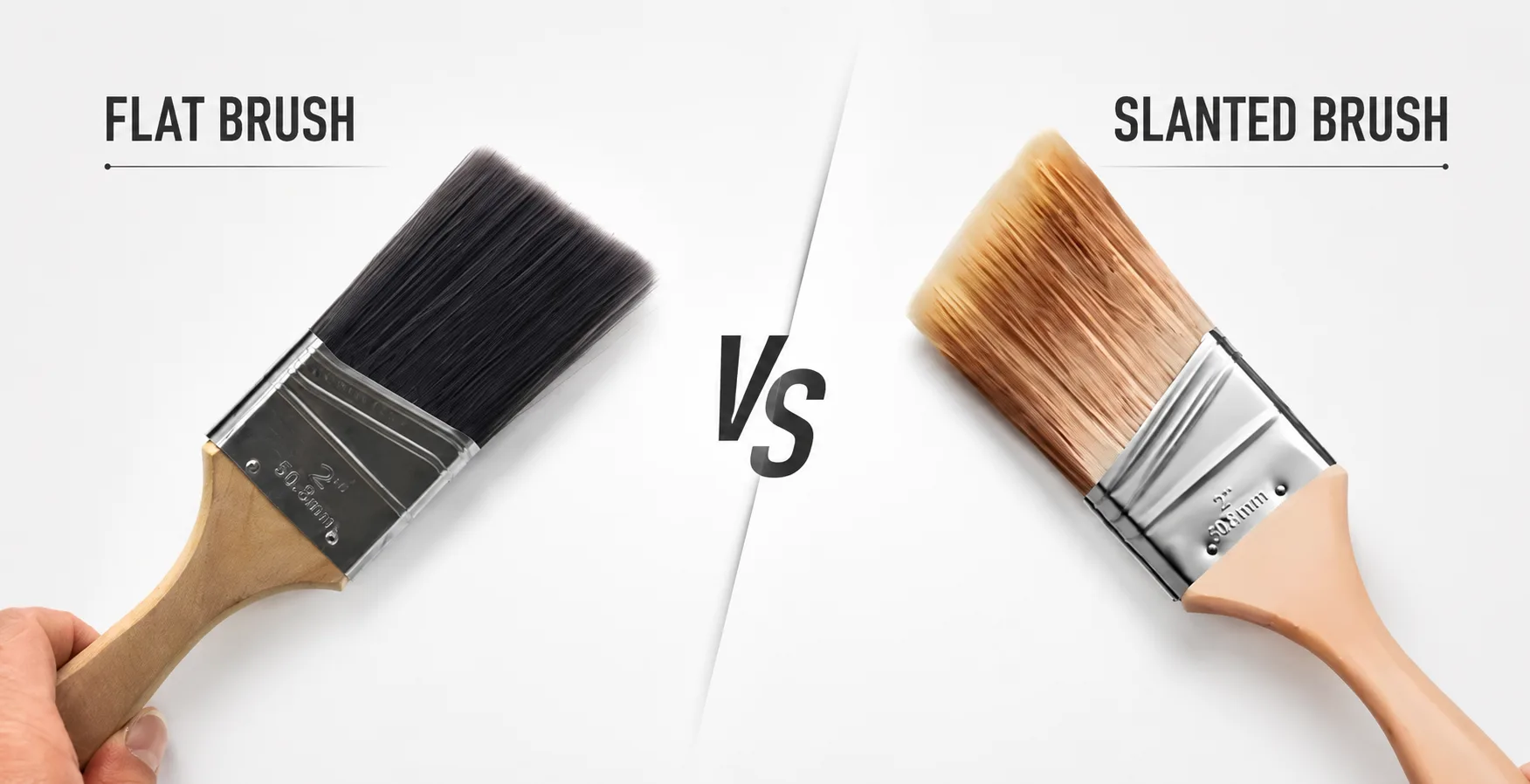
A Flat Brush is better for straight strokes, broad coverage, panels, doors, fences, furniture, and general surface painting. A Slanted Brush is better for cutting-in, edges, corners, trim, window frames, door frames, and areas where line control matters. For most painting projects, these two brushes are not competitors but complementary tools.
If the job involves wide, open, flat surfaces, choose a Flat Brush. If the job requires precision around borders, corners, or decorative details, choose a Slanted Brush. For professional painters, contractors, retailers, and distributors, offering both types helps customers complete more painting tasks with fewer mistakes and better finish quality.
Flat Brush vs Slanted Brush: Main Difference
The main difference is the shape of the bristle edge. A Flat Brush has a straight, even edge that creates broad and consistent strokes. A Slanted Brush has an angled edge that gives better access and control when painting along lines, corners, and narrow areas.
| Feature | Flat Brush | Slanted Brush |
|---|
| Bristle Shape | Straight and even edge | Angled cutting edge |
| Best Use | Flat surfaces, panels, doors, furniture, fences | Edges, corners, trims, frames, cutting-in |
| Coverage Speed | Faster on open surfaces | Slower on large surfaces but more precise |
| Line Control | Moderate | High |
| Beginner Friendliness | Easy for simple painting | Requires slightly better hand control |
| Commercial Positioning | General-purpose painting brush | Precision and trim painting brush |
What Is a Flat Brush?
A Flat Brush is a paint brush with a rectangular head and a straight bristle edge. It is one of the most common brush types in house painting and decorating because it is simple, versatile, and suitable for many general coating tasks.
Flat brushes are available in different widths, bristle materials, handle styles, and quality grades. They can be used with water-based paints, oil-based paints, primers, stains, varnishes, and other coatings when the bristle material is properly matched to the paint type.
Best Applications for Flat Brushes
Painting doors and wooden panels
Coating fences, boards, and shelves
Painting furniture surfaces
Applying primer on flat areas
Touching up medium-sized wall sections
General DIY and home improvement painting
Advantages of Flat Brushes
Efficient coverage: The straight edge covers flat surfaces quickly and evenly.
Simple operation: The brush is easy for beginners and professionals to use.
Good paint loading: A quality Flat Brush can hold enough paint for smooth strokes.
Wide size range: Flat brushes are available in narrow, medium, and wide formats.
Strong market demand: They are suitable for both retail and wholesale paint tool lines.
Limitations of Flat Brushes
Less precise than angled brushes for cutting-in
Not ideal for tight corners or narrow trim lines
Can create messy edges if used without masking or steady control
May be inefficient for highly detailed decorative work
What Is a Slanted Brush?
A Slanted Brush, also known as an angled paint brush, has bristles cut at an angle. This shape allows painters to create cleaner lines and reach corners more easily. It is especially useful when painting along ceilings, skirting boards, window frames, door frames, wall edges, and trim.
The angled tip gives users a more controlled contact point. Instead of pressing the full brush edge against the surface, painters can guide the angled bristles along a line. This makes the Slanted Brush a practical choice for precision work.
Best Applications for Slanted Brushes
Cutting in around ceilings and walls
Painting door frames and window frames
Coating baseboards and skirting boards
Painting corners and narrow edges
Working around switches, sockets, and fixtures
Detail painting where clean lines are required
Advantages of Slanted Brushes
Better edge control: The angled tip helps create cleaner paint lines.
Improved corner access: The brush reaches tight areas more easily than a flat edge.
Less dependence on masking tape: Skilled users can cut in accurately with less preparation.
Professional finish: Slanted brushes are valuable for trim, frames, and detail work.
Higher product positioning: They can be marketed as precision painting tools.
Limitations of Slanted Brushes
Not as fast as a Flat Brush for broad surface coverage
May take beginners more time to control properly
Angled tips can lose precision if bristles are low quality
Not always necessary for simple flat-area painting
Which Brush Is Better for Cutting In?
A Slanted Brush is usually the better choice for cutting in. Cutting in means painting straight lines along edges where two surfaces meet, such as where a wall meets a ceiling or where trim meets a wall. The angled bristle shape helps the painter guide the brush more accurately along the edge.
A Flat Brush can also be used for cutting in, especially by experienced painters, but it usually requires more control and may not reach corners as naturally. For most users, especially DIY customers and general contractors, a Slanted Brush makes edge painting easier and more consistent.
Which Brush Is Better for Large Flat Surfaces?
A Flat Brush is better for large flat surfaces because its straight edge allows wider and more even strokes. It can apply paint efficiently across doors, panels, furniture boards, fences, and medium-sized wall sections.
However, for very large smooth walls, a roller is usually faster than either brush. In that case, a Flat Brush can be used for smaller flat sections and a Slanted Brush can be used for edges and corners before or after rolling.
Which Brush Gives a Smoother Finish?
Both brush types can give a smooth finish when the bristle quality, paint type, and painting technique are correct. The brush shape alone does not determine smoothness. A high-quality Flat Brush can create smooth, straight strokes on panels and doors. A high-quality Slanted Brush can create clean, controlled finishes around trims and edges.
Brush marks are usually caused by poor bristle quality, wrong paint viscosity, excessive pressure, over-brushing, or using the wrong brush size for the surface. Buyers should compare bristle density, filament tip processing, ferrule strength, and handle comfort instead of judging only by brush shape.
Flat Brush vs Slanted Brush by Painting Task
| Painting Task | Better Choice | Reason |
|---|
| Painting a flat wooden door | Flat Brush | Provides straighter, wider, and more even strokes |
| Cutting in along ceiling lines | Slanted Brush | Angled edge improves line control |
| Painting window frames | Slanted Brush | Better for narrow edges and corners |
| Painting cabinets | Flat Brush or Slanted Brush | Flat Brush for panels, Slanted Brush for edges and details |
| Painting fences | Flat Brush | Faster coverage on boards and straight surfaces |
| Painting baseboards | Slanted Brush | Better control near floor and wall lines |
| General touch-up work | Depends on area | Flat Brush for open areas, Slanted Brush for edges |
Brush Size Matters as Much as Brush Shape
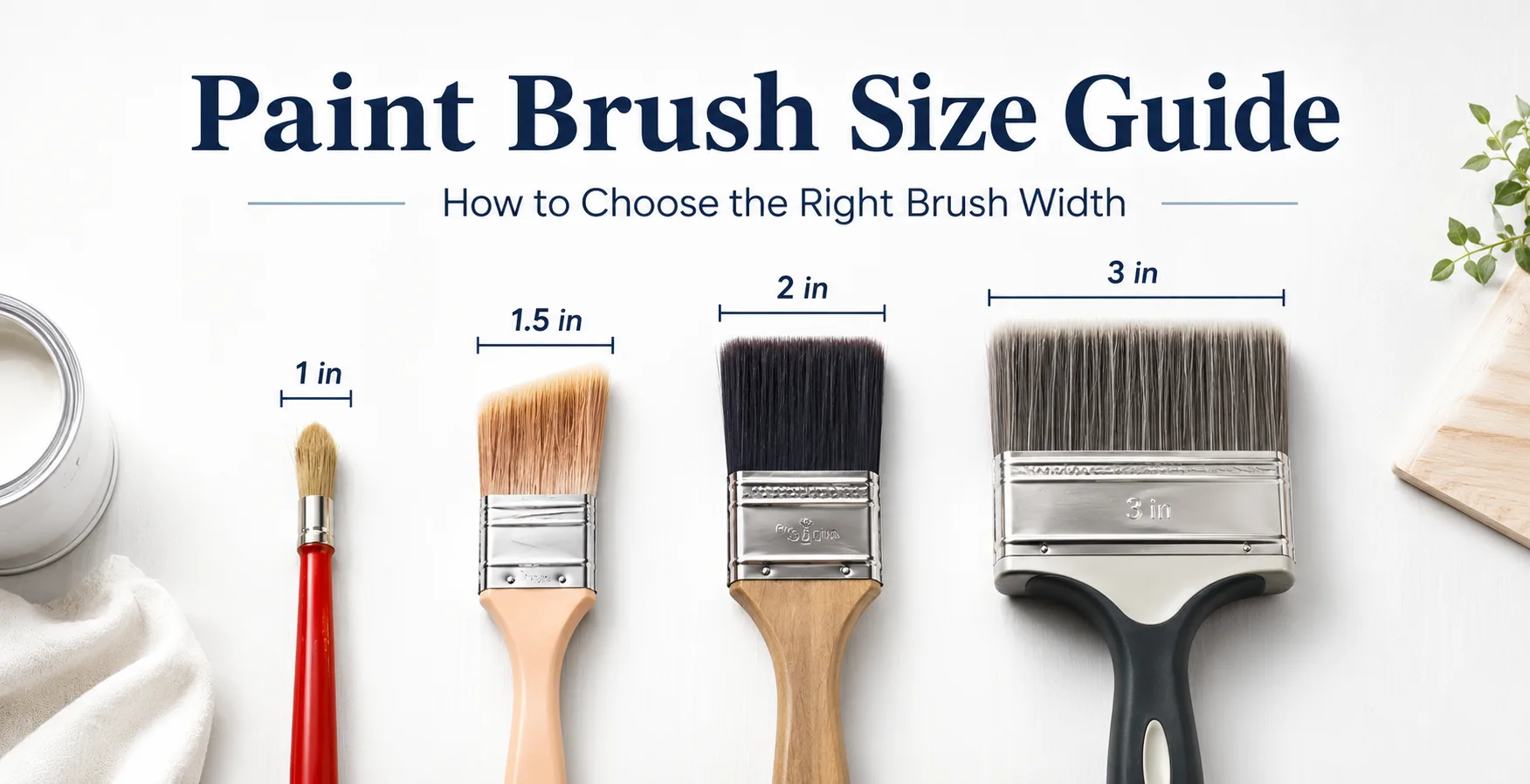
Choosing between Flat Brush and Slanted Brush is only part of the decision. Brush width also affects performance. A 1 inch brush is better for touch-ups and small details. A 2 inch brush is practical for trim, frames, and general home painting. A 3 inch Flat Brush is useful for panels and doors. A wider brush may be better for larger flat surfaces.
Recommended Sizes for Flat Brushes
1 inch: Small touch-ups, crafts, and narrow areas
2 inch: General home painting, furniture, trim, and panels
3 inch: Doors, fences, shelves, and medium flat surfaces
4 inch and above: Larger panels, wall sections, and exterior boards
Recommended Sizes for Slanted Brushes
1.5 inch: Small trim, corners, window grids, and detailed edges
2 inch: Most cutting-in and frame painting tasks
2.5 inch: Professional cutting-in with better paint loading
3 inch: Larger trim areas and faster edge work
Natural Bristle or Synthetic Filament: Which Is Better?
Both Flat Brush and Slanted Brush products can be made with natural bristles, synthetic filaments, or blended materials. The right choice depends mainly on the coating type.
For Water-Based Paint
Synthetic filaments are usually the better choice for latex paint, acrylic paint, water-based primer, and emulsion paint. Synthetic bristles maintain shape better when exposed to water and provide more stable control during painting.
For Oil-Based Paint, Varnish and Stain
Natural bristle brushes are often preferred for oil-based coatings, varnishes, and stains because they hold and release these materials smoothly. For furniture, wood finishing, and traditional coatings, natural bristles can provide strong finish value.
For All-Purpose Retail Brush Lines
For general retail and wholesale markets, synthetic Flat Brush and Slanted Brush products usually have broader demand because modern interior paints are commonly water-based. Natural bristle options can be added for specialty finishing and woodworking customers.
Durability and Quality Factors Buyers Should Compare
Bristle Density
Higher bristle density usually improves paint holding and smoother release. Sparse brushes may create uneven strokes and require more frequent dipping.
Filament Tip Processing
Flagged, tapered, or well-processed filament tips help reduce brush marks and improve paint control. This is especially important for Slanted Brush products used in cutting-in work.
Ferrule Strength
The ferrule connects the bristles to the handle. A weak ferrule can cause bristle shedding, looseness, and reduced service life. For professional users, ferrule durability is a major quality indicator.
Handle Comfort
Handle shape affects control and fatigue. A comfortable handle is especially important for trim painting, cutting-in, and long working sessions where precise hand movement is required.
Shape Recovery
A quality brush should return to shape after pressure. This is critical for Slanted Brush products because edge precision depends on the angled tip remaining stable after repeated use.
Cost Comparison: Which Brush Offers Better Value?
A basic Flat Brush is often more economical because the shape is simple and the application range is broad. It is suitable for high-volume retail and wholesale demand. A Slanted Brush may cost slightly more in higher-quality versions because edge precision, filament shaping, and tip control are more important.
From a long-term value perspective, the better brush is the one that matches the task. A low-cost Flat Brush used for precision trim work may increase rework. A Slanted Brush used for large flat panels may slow down the job. Correct product matching reduces labor time, paint waste, and user frustration.
Which Brush Should Retailers and Wholesalers Prioritize?
For paint tool distributors, hardware stores, and importers, both Flat Brush and Slanted Brush products should be included in the core product range. The Flat Brush covers broad general demand, while the Slanted Brush satisfies customers looking for better edge control and professional-looking results.
Recommended Basic Product Range
1 inch and 2 inch Flat Brush for DIY and touch-up work
2 inch and 3 inch Flat Brush for general painting and furniture
1.5 inch and 2 inch Slanted Brush for trim and edges
2.5 inch Slanted Brush for professional cutting-in
Mixed brush sets combining flat and angled brushes
Why Brush Sets Can Improve Sales
Many end users are unsure whether they need a Flat Brush or Slanted Brush. A mixed brush set solves this problem by giving customers both coverage and precision options. For retail channels, brush sets can improve perceived value and reduce selection difficulty.
Common Mistakes When Choosing Between Flat and Slanted Brushes
Using a Flat Brush for All Edge Work
A Flat Brush can paint edges, but it is not always the most efficient choice. For ceiling lines, door frames, window frames, and baseboards, a Slanted Brush usually provides better control and cleaner results.
Using a Slanted Brush for Large Open Surfaces
A Slanted Brush is designed for precision, not maximum coverage. Using it on large flat surfaces can slow down the job and may create uneven stroke patterns if the painter does not maintain consistent pressure.
Choosing Brush Shape Without Considering Paint Type
Brush shape affects control, but bristle material affects coating compatibility. Synthetic brushes are usually better for water-based paints, while natural bristle brushes are often better for oil-based coatings and stains.
Buying Only the Cheapest Brush
Low-cost brushes may shed bristles, lose shape, or leave visible marks. For professional users and brand buyers, quality consistency is more important than the lowest unit price.
FAQ: Flat Brush vs Slanted Brush
Is a Flat Brush better than a Slanted Brush?
A Flat Brush is better for broad, straight, and flat surfaces. A Slanted Brush is better for edges, corners, trim, and cutting-in. The better choice depends on the painting task rather than one brush being universally better.
What is a Slanted Brush used for?
A Slanted Brush is used for cutting-in, painting along ceiling lines, coating trims, window frames, door frames, baseboards, and corners. Its angled edge improves precision and line control.
Can I use a Flat Brush for cutting in?
Yes, a Flat Brush can be used for cutting in, especially by experienced painters. However, most users find a Slanted Brush easier and more accurate for edge work.
What brush should I use for painting doors?
A Flat Brush is usually suitable for large flat door panels. A Slanted Brush can be used around door edges, frames, grooves, and detailed sections. For best results, many painters use both.
Which brush is best for beginners?
For simple surface painting, a Flat Brush is easier for beginners. For edge painting and trim work, a Slanted Brush can help beginners achieve cleaner lines with less correction.
Should wholesalers stock both Flat Brush and Slanted Brush products?
Yes. Flat Brush products cover general painting demand, while Slanted Brush products serve precision painting needs. Stocking both types allows buyers to serve DIY users, decorators, contractors, and professional painters more effectively.
Final Recommendation
Choose a Flat Brush for broad, flat surfaces where coverage speed and straight strokes matter. Choose a Slanted Brush for edges, corners, trims, frames, and cutting-in where precision matters. For most painting projects, the best result comes from using both tools together.
For commercial buyers, a balanced brush product line should include multiple sizes of Flat Brush and Slanted Brush products with clear application guidance. This helps customers choose correctly, improves painting results, reduces product misuse, and supports stronger repeat sales in the house painting and decorating tools market.
 English