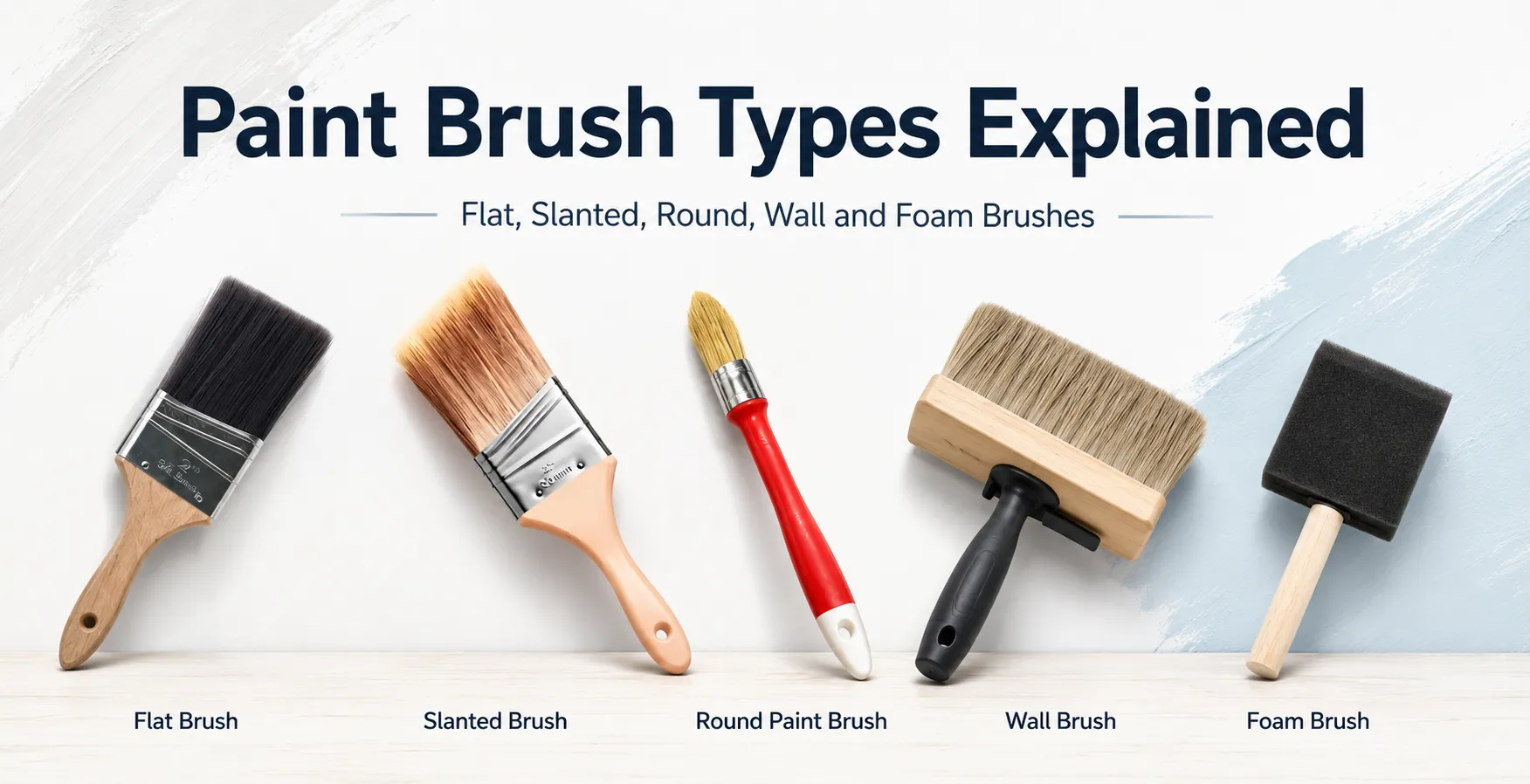
Choosing the right Paint Brush is not only about brush shape. It directly affects paint control, surface finish, working speed, material waste, and the final appearance of the job. For professional decorators, contractors, wholesalers, and DIY retailers, understanding the difference between Flat Brush, Slanted Brush, round brush, Wall Brush, and foam brush helps match the right tool to the right application.
A Flat Brush is usually better for broad, straight strokes and general coating work. A Slanted Brush gives more control around edges, corners, trims, and cutting-in. A Wall Brush is designed for larger surface coverage. Round brushes are useful for detailed, curved, or decorative work. Foam brushes are cost-effective for smooth coatings, touch-ups, and disposable use, but they are not always ideal for heavy-duty professional painting.
Why Paint Brush Type Matters in Real Painting Work
Different brush types are designed to solve different painting problems. A brush that works well for a wooden door may not perform well on a textured wall or narrow window frame. If the brush is too soft, it may not carry enough paint. If it is too stiff, it may leave visible marks. If the shape is wrong, workers spend more time correcting edges and overlaps.
For buyers, the right Paint Brush selection can improve three important areas:
Efficiency: The correct brush covers the surface faster and reduces rework.
Finish quality: Proper bristle shape and density help reduce streaks, brush marks, and uneven paint distribution.
Cost control: A durable brush lowers replacement frequency and reduces paint waste.
Flat Brush: Best for Straight Coverage and General Painting
A Flat Brush has a straight edge and a rectangular brush head. It is one of the most common brush types used in house painting, furniture painting, wall edges, doors, panels, and general surface coating. The straight shape allows painters to apply paint evenly across flat areas and create consistent strokes.
When Should You Use a Flat Brush?
A Flat Brush is suitable when the work area is relatively open and does not require complicated edge control. It performs well on flat wooden boards, cabinet panels, doors, fences, and medium-sized wall sections where a roller may not reach conveniently.
For commercial buyers, Flat Brush products are usually a strong category because they meet a wide range of daily painting needs. They are easy to explain to end users, suitable for both professional and DIY markets, and available in many sizes.
Advantages of Flat Brushes
Good paint holding capacity for medium and broad strokes
Simple shape, easy for beginners and professionals to use
Suitable for oil-based and water-based coatings depending on bristle material
Available in multiple widths for different painting areas
Limitations of Flat Brushes
Less precise than angled brushes for cutting-in
May not be the best option for narrow corners or decorative lines
Low-quality flat brushes may shed bristles or leave visible marks
Slanted Brush: Better Control for Edges, Corners and Trim
A Slanted Brush, also called an angled brush, has bristles cut at an angle. This design gives painters better control when painting along edges, corners, baseboards, door frames, window frames, and ceiling lines. Compared with a Flat Brush, the angled tip helps users reach narrow areas more accurately.
Is a Slanted Brush Better Than a Flat Brush?
A Slanted Brush is better for precision work, while a Flat Brush is better for broader, straight coverage. For professional decorating projects, both brush types are often used together. The Slanted Brush handles cutting-in and detail areas, while the Flat Brush or roller covers larger surfaces.
Best Applications for Slanted Brushes
Cutting in around walls, ceilings, and trims
Painting window frames and door frames
Working around switches, sockets, and narrow edges
Detail painting where a clean line is required
Purchasing Considerations for Slanted Brushes
When sourcing Slanted Brush products, buyers should pay attention to bristle elasticity, handle comfort, ferrule strength, and edge sharpness. A poorly shaped angled brush may lose its cutting-in advantage quickly after repeated use. For professional-grade products, the bristles should return to shape after pressure and hold paint without excessive dripping.
Round Brush: Useful for Detail, Curves and Decorative Work
Round brushes have a circular brush head and are often used for detailed painting, curved surfaces, furniture decoration, pipes, railings, crafts, and touch-up work. They are less common for large wall painting but valuable in specialized applications.
Where Round Brushes Perform Best
Round brushes are useful when the surface is not flat or when the painter needs controlled paint placement. For example, a round brush can work well around carved furniture, metal railings, decorative moldings, and small repair areas.
For retailers and distributors, round brushes can complement standard Paint Brush product lines by covering niche use cases. They are especially relevant for customers involved in decoration, restoration, crafts, or detailed finishing.
Wall Brush: Designed for Larger Surface Coverage
A Wall Brush is generally wider and thicker than standard trim brushes. It is designed to hold more paint and cover larger wall surfaces more quickly. Although paint rollers are commonly used for walls, Wall Brush products remain useful for edges, textured surfaces, masonry, exterior walls, rough surfaces, and areas where a roller is less practical.
When Is a Wall Brush Better Than a Roller?
A Wall Brush may be better than a roller when the surface is rough, uneven, narrow, or difficult to access. Brushes can push paint into pores, gaps, and textured areas more effectively than some rollers. This is especially useful for brick, concrete, stucco, fences, and exterior repair work.
Advantages of Wall Brushes
High paint loading capacity
Good for rough or textured surfaces
Useful for outdoor walls, fences, and masonry
Can reach areas where rollers are not convenient
What to Check Before Buying Wall Brushes
For Wall Brush sourcing, the key factors are bristle density, brush width, handle strength, and ferrule durability. Since wall painting often requires repeated pressure, a weak handle or loose ferrule can shorten the tool’s service life. Buyers serving contractors should consider thicker brush heads and durable handles for better long-term value.
Foam Brush: Smooth Application for Light-Duty and Disposable Use
Foam brushes are made with sponge-like foam heads instead of traditional bristles. They are commonly used for staining, varnishing, touch-ups, craft work, and smooth coating applications. Foam brushes are often inexpensive and disposable, making them attractive for one-time use or small projects.
Are Foam Brushes Good for Painting Walls?
Foam brushes are not usually the best choice for full wall painting. They do not hold as much paint as a Wall Brush or roller, and they may wear out quickly on rough surfaces. However, they can be useful for small touch-ups, corners, sample paint testing, and smooth decorative surfaces.
Foam Brush Advantages
Low cost for disposable or short-term use
Smooth finish on small flat surfaces
Good for stains, varnishes, sealers, and craft coatings
No bristle shedding
Foam Brush Limitations
Not ideal for rough walls or large areas
Lower durability than quality bristle brushes
Can absorb too much coating if the foam density is poor
May leave bubbles if used with the wrong technique or coating
Paint Brush Type Comparison Table
| Brush Type | Best For | Main Advantage | Possible Limitation |
|---|
| Flat Brush | Doors, panels, furniture, general flat surfaces | Even coverage and simple operation | Less precise for cutting-in |
| Slanted Brush | Edges, trims, corners, ceiling lines | Better control and cleaner lines | Not as efficient for large open surfaces |
| Round Brush | Curves, details, pipes, decorative work | Good control on small or shaped areas | Limited coverage speed |
| Wall Brush | Walls, masonry, fences, rough surfaces | High paint loading and strong surface penetration | May be too large for fine detail work |
| Foam Brush | Touch-ups, stains, varnishes, crafts | Low cost and smooth small-area application | Lower durability and limited paint capacity |
How to Choose the Right Paint Brush for Your Project
For Interior Wall Painting
Use a Wall Brush for edges, rough areas, and places where rollers cannot reach. For cutting-in around ceilings and trims, combine it with a Slanted Brush. This combination improves both speed and line quality.
For Doors, Cabinets and Wooden Panels
A Flat Brush is usually a practical choice because it provides smooth, straight coverage. If the surface has narrow details or decorative edges, add a Slanted Brush or round brush for better control.
For Trim, Baseboards and Window Frames
A Slanted Brush is usually the better option. Its angled bristle shape helps create cleaner edges and reduces the need for masking or correction.
For Rough Exterior Surfaces
A Wall Brush with strong bristles and a durable handle is more suitable. It can push paint into uneven textures better than a small Flat Brush or foam brush.
For Staining and Touch-Up Work
Foam brushes are cost-effective for small projects, especially when users do not want to clean the brush after use. However, for repeated professional use, a higher-quality Paint Brush is usually more economical over time.
Key Quality Factors Buyers Should Compare
For distributors, wholesalers, hardware stores, and brand owners, brush type is only one part of the selection process. Product quality depends on several manufacturing details:
Bristle material: Natural bristles, synthetic filaments, or blended bristles affect paint compatibility and finish quality.
Bristle density: Denser brushes usually hold more paint and provide smoother application.
Ferrule strength: A secure ferrule prevents bristle loss and handle loosening.
Handle design: Comfortable wooden or plastic handles improve control during long painting jobs.
Brush edge shape: Flat, angled, rounded, or wide brush shapes should match the intended use.
Common Mistakes When Selecting Paint Brushes
Choosing One Brush for Every Job
No single Paint Brush is ideal for all surfaces. A Flat Brush may work well on panels but struggle with tight corners. A Slanted Brush may create clean edges but take too long on large surfaces. Professional results usually require a combination of brush types.
Ignoring Paint Type
Water-based paints often work best with synthetic bristles because they maintain stiffness better when wet. Oil-based paints may work well with natural bristles or suitable blends. Matching brush material to paint type improves finish and durability.
Buying Only by Price
Low-cost brushes may be acceptable for disposable use, but they can cause bristle shedding, uneven coating, and more labor time. For professional painting or retail product lines, a slightly higher-quality brush often provides better long-term value.
FAQ: Paint Brush Types
What is the most versatile Paint Brush type?
A Flat Brush is one of the most versatile choices for general painting because it works well on many flat surfaces. However, for a complete painting kit, it is better to include a Flat Brush, Slanted Brush, and Wall Brush.
What brush is best for cutting in?
A Slanted Brush is usually the best choice for cutting in around ceilings, corners, trims, and frames. The angled bristle edge gives better line control than a standard flat edge.
Can a Wall Brush replace a roller?
A Wall Brush can replace a roller in some areas, especially on rough, narrow, or textured surfaces. For large smooth walls, rollers are usually faster, while Wall Brush products are better for edges, corners, masonry, and detailed wall work.
Are foam brushes worth buying?
Foam brushes are worth buying for small, light-duty, or disposable applications. They are useful for stains, varnishes, touch-ups, and crafts, but they are not the best option for heavy-duty wall painting or repeated professional use.
Which Paint Brush type should wholesalers stock first?
For a balanced product range, wholesalers should usually prioritize Flat Brush, Slanted Brush, and Wall Brush products first. These cover the most common house painting and decorating needs. Foam and round brushes can then be added for touch-up, craft, and detail applications.
Final Recommendation
The best brush type depends on the surface, coating, finish requirement, and working method. A Flat Brush is practical for general surface coverage, a Slanted Brush is better for precision edges, a Wall Brush is suitable for larger or rougher surfaces, a round brush supports detail work, and a foam brush is useful for low-cost touch-ups and smooth light-duty coatings.
For buyers building a complete painting tools product line, the most practical approach is to offer multiple Paint Brush types with clear application positioning. This helps customers choose faster, reduces product mismatch, and improves satisfaction after purchase.
 English