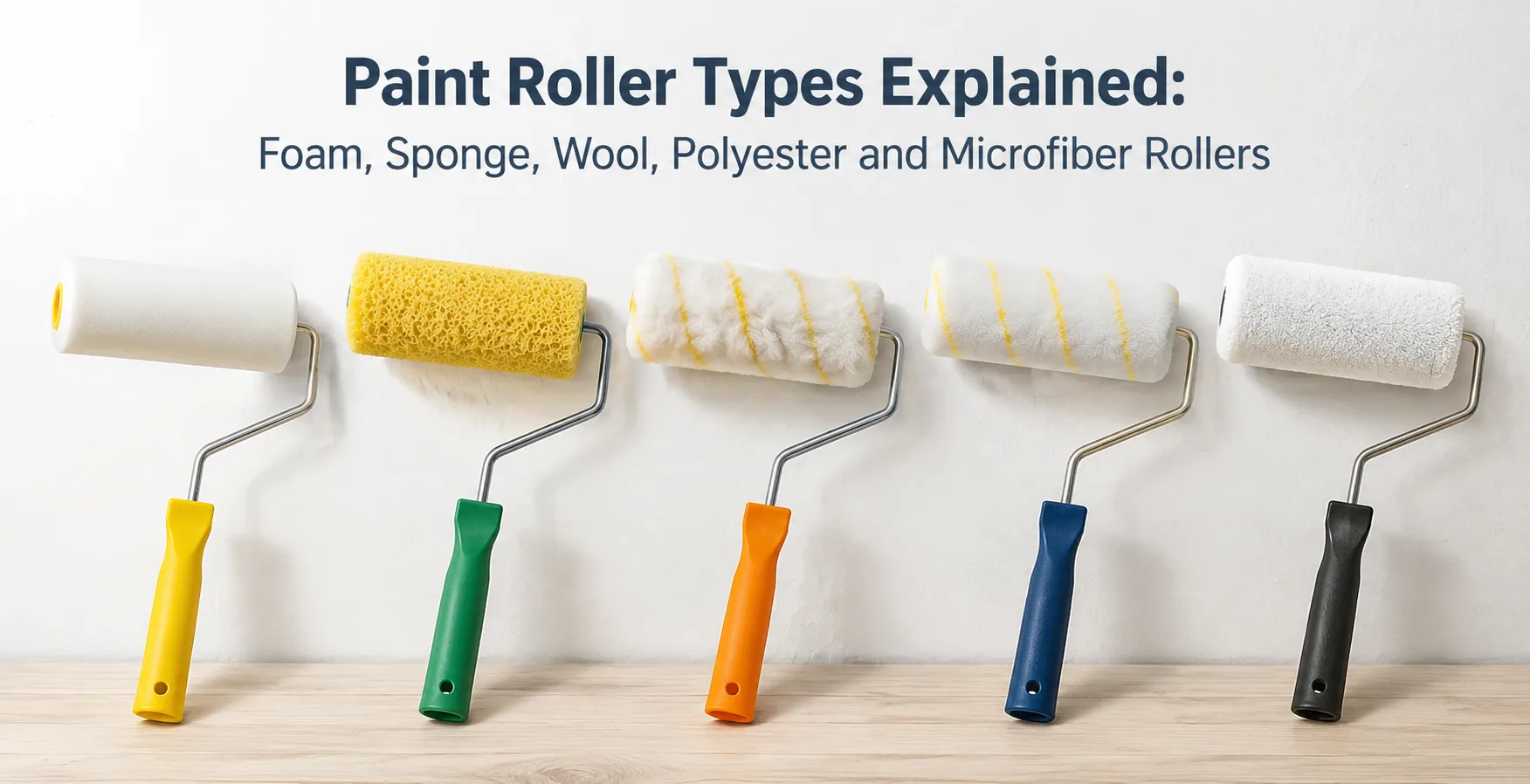
The right Roller Brush can improve paint coverage, reduce labor time, control surface texture, and help achieve a more consistent finish. Foam, sponge, wool, polyester, and microfiber rollers are not interchangeable. Each roller material performs differently depending on the coating type, wall condition, surface texture, and expected finish quality.
A Foam Roller is best for smooth surfaces and fine finishes. Sponge rollers are often used for decorative effects and textured applications. Wool rollers offer strong paint loading and are suitable for rough or exterior surfaces. A Polyester Roller is a practical all-purpose option for water-based paints and general wall painting. A microfiber or Super Fiber Roller provides excellent paint pickup, smooth release, and high-efficiency coverage for professional interior work.
Why Roller Brush Material Matters
Many buyers compare rollers mainly by size and price, but the roller cover material is equally important. The material affects how much paint the roller absorbs, how evenly it releases paint, how smooth the finish looks, and how long the roller lasts during repeated use.
For contractors, decorators, wholesalers, and paint tool distributors, selecting the right Roller Brush range can directly influence user satisfaction. A roller that sheds fibers, leaves lint, creates bubbles, or wears out too quickly can increase complaints even if the paint itself is high quality.
When choosing roller types, buyers should consider:
Surface texture: Smooth walls, rough plaster, brick, concrete, wood, and metal require different roller materials.
Paint type: Water-based paint, oil-based paint, primer, varnish, stain, and textured coatings behave differently.
Finish requirement: Fine finish, standard wall finish, textured effect, or heavy coverage.
Durability: Some rollers are designed for disposable use, while others are suitable for repeated professional projects.
Cost efficiency: A higher-quality roller may cost more initially but can reduce paint waste and rework.
Foam Roller: Best for Smooth Surfaces and Fine Finishes
A Foam Roller uses a smooth foam cover instead of woven or knitted fibers. It is commonly used for cabinets, doors, furniture, metal panels, smooth wood, and small interior projects where a fine finish is required.
When Should You Use a Foam Roller?
A Foam Roller is suitable when the surface is smooth and the goal is to minimize texture. It works well with many water-based paints, varnishes, stains, and clear coatings, depending on foam density and coating viscosity.
For example, when painting a flat cabinet door or a smooth wooden panel, a Foam Roller can create a cleaner appearance than a thick-nap fabric roller. It is also useful for touch-up work where a heavy texture would look inconsistent.
Advantages of Foam Rollers
Creates a smooth finish on flat surfaces
Good for doors, cabinets, furniture, and trim panels
Low lint risk compared with low-quality fabric rollers
Often economical for small projects and light-duty use
Limitations of Foam Rollers
Not suitable for rough or textured walls
May create bubbles if rolled too quickly or used with unsuitable coatings
Usually holds less paint than wool, polyester, or microfiber rollers
Lower durability under heavy pressure or rough surface conditions
Sponge Roller: Useful for Decorative and Textured Effects
Sponge rollers are made with porous sponge material and are often used for decorative painting, special texture effects, faux finishes, and craft-style applications. They are less common for standard wall coating but useful in design-oriented projects.
What Is a Sponge Roller Used For?
A sponge roller is usually selected when the user wants a visible pattern, soft texture, or decorative finish. It can be used on accent walls, furniture, art surfaces, or specialty wall finishes. Unlike a standard Roller Brush designed for uniform paint coverage, a sponge roller often creates a more irregular and decorative appearance.
Advantages of Sponge Rollers
Good for decorative wall effects
Creates textured patterns without complex tools
Useful for crafts, furniture effects, and accent surfaces
Easy to position as a specialty item in retail product lines
Limitations of Sponge Rollers
Not ideal for uniform full-wall painting
Paint distribution can be less predictable
Durability depends heavily on sponge quality
May not meet the expectations of users looking for a smooth finish
Wool Roller: Strong Paint Loading for Rough and Exterior Surfaces
Wool rollers are known for excellent paint absorption and release. They are commonly used on rough walls, exterior surfaces, masonry, concrete, plaster, brick, and textured coatings. Natural wool and wool-blend rollers are especially valued in professional applications where high coverage and durability are important.
When Is a Wool Roller Better Than Other Rollers?
A wool roller is often better when the surface is rough, porous, or uneven. Because wool fibers hold more paint, the roller can cover deeper textures more effectively than a Foam Roller or short-nap synthetic roller.
For exterior projects, a wool roller can reduce the number of passes needed to fill surface gaps and pores. This makes it useful for contractors working on large surfaces where productivity matters.
Advantages of Wool Rollers
Excellent paint holding capacity
Good coverage on rough and textured surfaces
Suitable for masonry, plaster, concrete, and exterior walls
Efficient for large-area coating work
Limitations of Wool Rollers
May leave more texture on smooth surfaces
Usually requires proper cleaning and maintenance
Can be more expensive than basic synthetic rollers
Low-quality wool rollers may shed fibers if not manufactured well
Polyester Roller: Practical Choice for General Wall Painting
A Polyester Roller is widely used for interior wall painting, ceilings, primers, and general-purpose coating work. Polyester fibers are durable, resistant to many water-based paints, and suitable for cost-effective roller production.
Why Are Polyester Rollers So Common?
Polyester rollers provide a good balance of price, durability, and performance. They are suitable for many standard house painting projects, making them popular with hardware stores, wholesalers, contractors, and DIY users.
For commercial buyers, Polyester Roller products are often easy to sell because they cover broad demand. They can be offered in different nap lengths, frame sizes, packaging styles, and quality grades.
Advantages of Polyester Rollers
Good all-purpose performance for interior walls and ceilings
Compatible with many water-based paints and primers
Durable enough for repeated use when properly cleaned
Cost-effective for bulk purchasing and retail sales
Limitations of Polyester Rollers
May not provide the same paint pickup as microfiber or wool
Finish quality depends on fiber density and nap construction
Lower-grade polyester rollers may shed or flatten quickly
Not always the best choice for ultra-smooth cabinet or furniture finishes
Microfiber and Super Fiber Roller: High Paint Pickup and Smooth Release
Microfiber rollers, sometimes promoted as Super Fiber Roller products, are designed with very fine synthetic fibers. These rollers are valued for their strong paint absorption, controlled release, and smooth finish. They are often used for interior walls, ceilings, primers, and professional finishing work.
What Makes a Super Fiber Roller Different?
A Super Fiber Roller usually has finer and denser fibers than a basic polyester roller. This allows it to pick up more paint and release it more evenly. The result is better coverage, fewer roller marks, and improved efficiency on many smooth to medium-textured surfaces.
Best Applications for Microfiber Rollers
Interior walls and ceilings
Smooth to medium-textured surfaces
Professional residential and commercial painting
Water-based paints, primers, and many modern coatings
Advantages of Microfiber and Super Fiber Rollers
Excellent paint pickup and release
Helps reduce splatter compared with low-quality rollers
Provides smooth and consistent coverage
Good productivity for professional painters
Suitable for higher-value roller product lines
Limitations of Microfiber Rollers
Usually costs more than basic polyester rollers
May not be necessary for rough exterior surfaces
Requires proper cleaning to maintain performance
Quality varies significantly between manufacturers
Paint Roller Type Comparison Table
| Roller Type | Best For | Main Advantage | Possible Limitation |
|---|
| Foam Roller | Doors, cabinets, furniture, smooth panels | Smooth finish with low lint risk | Not suitable for rough or large textured walls |
| Sponge Roller | Decorative effects, faux finishes, crafts | Creates special patterns and textures | Not ideal for uniform wall coverage |
| Wool Roller | Rough walls, masonry, exterior surfaces | High paint loading and strong coverage | May leave too much texture on smooth surfaces |
| Polyester Roller | General walls, ceilings, primers | Cost-effective and versatile | Performance depends heavily on fiber quality |
| Super Fiber Roller | Interior walls, ceilings, professional finish work | Excellent paint pickup and smooth release | Higher cost than basic synthetic rollers |
How to Choose the Right Roller Brush for Different Surfaces
For Smooth Doors, Cabinets and Furniture
Choose a Foam Roller when the surface is very smooth and the finish needs to look clean with minimal texture. For best results, avoid overloading the roller with paint and roll at a controlled speed to reduce bubbles.
For Standard Interior Walls
A Polyester Roller or Super Fiber Roller is usually the most practical option. Polyester rollers are cost-effective for general painting, while Super Fiber Roller products are better when smoother coverage and higher productivity are required.
For Ceilings
Microfiber or polyester rollers are commonly used for ceilings. A roller with good paint holding capacity can reduce repeated dipping and help maintain consistent coverage above head level.
For Rough Plaster, Concrete and Brick
A wool roller is often the better choice because it holds more paint and reaches uneven surface areas more effectively. For very rough surfaces, choosing the correct nap length is also important.
For Decorative Painting
Sponge rollers are suitable for special effects, accent walls, and textured finishes. They should not be positioned as a replacement for standard wall rollers unless the user specifically wants a decorative result.
Which Roller Is Best for Water-Based Paint?
For most water-based wall paints, Polyester Roller and Super Fiber Roller options are practical choices. Polyester rollers offer good value for standard projects, while microfiber or Super Fiber Roller products usually provide better paint pickup and release for more efficient work.
Foam rollers can also work with water-based coatings on smooth surfaces, but they are not the best option for large walls. Wool rollers may be suitable for water-based paints on rough surfaces, especially when strong coverage is required.
Which Roller Gives the Smoothest Finish?
For very smooth surfaces such as doors, cabinets, and flat panels, a Foam Roller often gives one of the smoothest finishes. For walls and ceilings, a high-quality microfiber or Super Fiber Roller can provide a smooth, even appearance while still holding enough paint for efficient coverage.
The smoothness of the final finish also depends on paint viscosity, surface preparation, roller nap length, rolling technique, and drying conditions. Even the best Roller Brush cannot fully compensate for dusty, uneven, or poorly primed surfaces.
Commercial Buying Considerations for Roller Brush Products
Fiber Shedding and Lint Control
Low-quality rollers may leave lint or loose fibers in the paint film. This is a major concern for professional users because it affects the final appearance and increases rework. Buyers should check roller cover bonding, fiber stability, and pre-use shedding performance.
Paint Loading and Release
A good Roller Brush should absorb enough paint but release it evenly. If the roller holds too little paint, users need to reload frequently. If it releases too much paint at once, it may cause drips, splatter, or uneven coating thickness.
Core Strength and Frame Fit
The roller cover core should remain stable during use and fit securely with standard roller frames. Weak cores may deform, loosen, or slip during painting, especially in large projects.
Packaging and Product Positioning
For retail and wholesale channels, clear packaging can help customers choose faster. Products can be grouped by use case, such as smooth finish rollers, general wall rollers, exterior wall rollers, and decorative rollers.
Common Mistakes When Choosing Paint Rollers
Using Foam Rollers on Rough Walls
A Foam Roller is not designed for rough walls or heavy-texture surfaces. It may break down quickly and fail to push paint into uneven areas. Wool, polyester, or microfiber rollers are usually better for wall painting.
Choosing Only the Cheapest Roller
Very cheap rollers may seem economical, but they can shed fibers, absorb paint unevenly, and wear out quickly. For professional users, a poor roller can cost more in wasted paint and extra labor.
Ignoring Surface Texture
Surface texture determines both roller material and nap length. Smooth surfaces need shorter nap and finer materials, while rough surfaces need thicker nap and stronger paint loading capacity.
Using One Roller Type for Every Paint
Different coatings have different viscosities and finish requirements. A roller that works well for primer may not be ideal for varnish, stain, or high-gloss paint. Matching roller material to coating type improves both appearance and durability.
FAQ: Paint Roller Types
What is the best Roller Brush for beginners?
For general wall painting, a Polyester Roller is often a practical beginner choice because it is affordable, easy to use, and suitable for many common water-based paints. For better coverage and smoother operation, a Super Fiber Roller can be a higher-performance option.
Is a Foam Roller better than a fabric roller?
A Foam Roller is better for smooth surfaces and fine finishes, while fabric rollers such as polyester, wool, or microfiber are better for walls, ceilings, and textured surfaces. The better choice depends on the surface and coating.
Are microfiber rollers worth the higher cost?
Microfiber and Super Fiber Roller products are often worth the cost for professional painting because they hold more paint, release it smoothly, and can improve working efficiency. For one-time small projects, a basic polyester roller may be sufficient.
Which roller should be used for rough exterior walls?
Wool rollers are often suitable for rough exterior walls because they have strong paint loading capacity and can reach uneven surfaces more effectively. The roller should also have an appropriate nap thickness for the surface texture.
What roller type should wholesalers stock?
Wholesalers should usually stock Polyester Roller products for general demand, Foam Roller products for smooth finish applications, wool rollers for rough surfaces, and Super Fiber Roller products for professional users who want better coverage and finish quality.
Final Recommendation
Each Roller Brush type has a clear role. Foam rollers are best for smooth surfaces and fine finishes. Sponge rollers are useful for decorative effects. Wool rollers provide strong coverage on rough and exterior surfaces. Polyester rollers offer practical value for general painting. Microfiber and Super Fiber Roller products are strong choices for professional interior work where paint pickup, smooth release, and efficiency matter.
For buyers building a complete paint roller product line, the best strategy is to match roller types with real application scenarios. This makes product selection easier for customers, reduces misuse, and supports stronger long-term sales performance.
 English