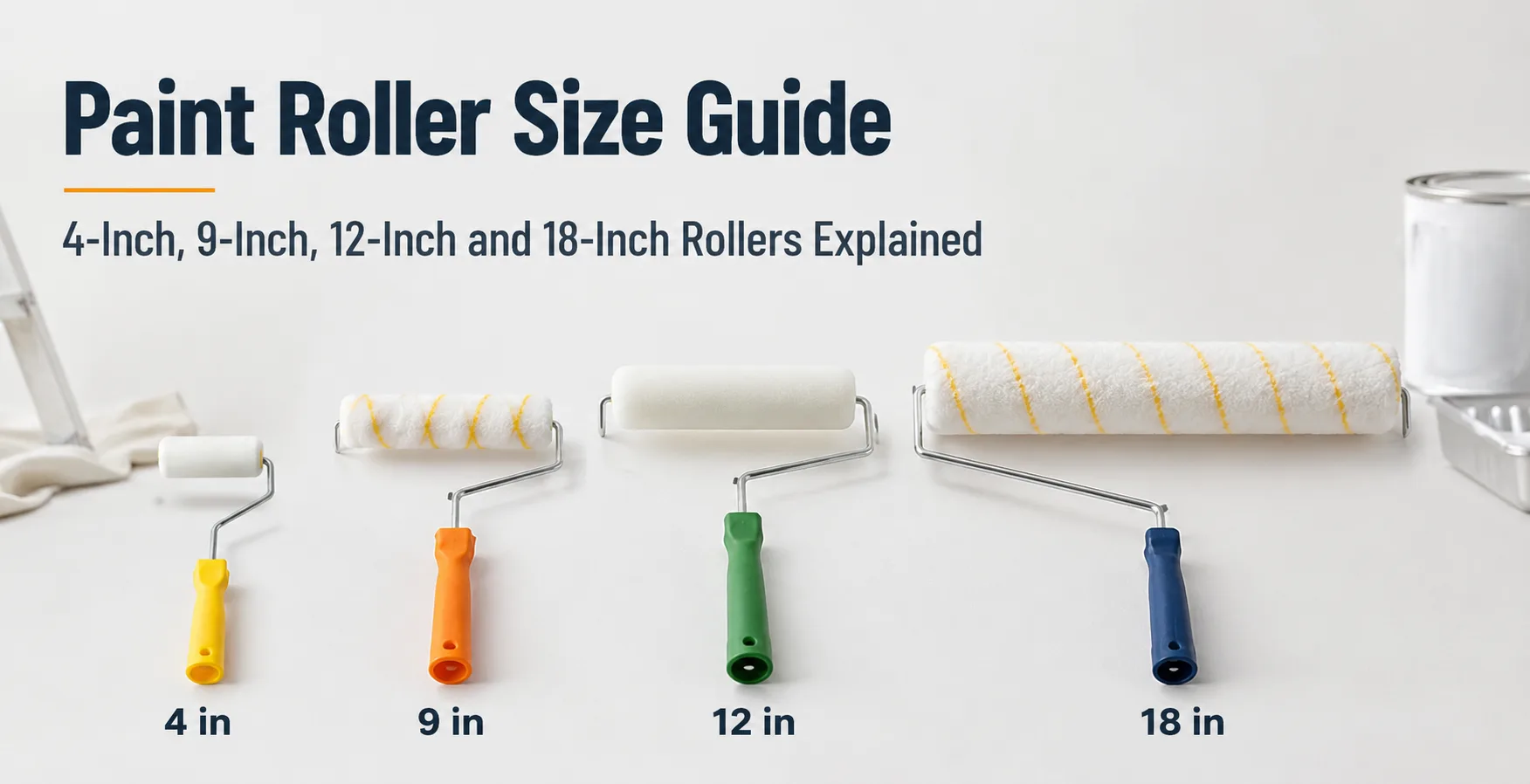
The right paint roller size depends on the surface area, working space, coating type, project speed, and finish requirement. A 4-inch roller is best for small areas, trim, cabinets, doors, edges, and touch-ups. A 9-inch roller is the most practical standard size for interior walls and ceilings. A 12-inch roller covers more area per pass and is suitable for larger rooms and commercial interiors. An 18-inch roller is designed for high-productivity painting on large walls, floors, ceilings, warehouses, and exterior surfaces.
For contractors, distributors, wholesalers, and paint tool buyers, roller size is not just a simple dimension. It affects labor cost, paint loading, user fatigue, surface consistency, packaging strategy, shipping cost, and product positioning. Choosing the right roller size helps users work faster, reduce overlap marks, and improve the final coating result.
Paint Roller Size Comparison Table
| Roller Size | Best Use | Main Advantage | Main Limitation | Typical User |
|---|
| 4-Inch Roller | Trim, cabinets, doors, corners, small panels, touch-ups | High control in narrow areas | Too slow for large walls | DIY users, decorators, furniture painters |
| 9-Inch Roller | Interior walls, ceilings, general house painting | Balanced speed, control, and availability | Less efficient for very large surfaces | Homeowners, painters, contractors, retailers |
| 12-Inch Roller | Large rooms, commercial interiors, wide wall sections | Faster coverage than 9-inch rollers | Requires more control and wider trays | Professional painters, renovation teams |
| 18-Inch Roller | Warehouses, exterior walls, floors, ceilings, large commercial projects | Maximum productivity on large surfaces | Heavy when loaded and less suitable for tight spaces | Commercial contractors, industrial coating teams |
Why Paint Roller Size Matters
Paint roller size affects how much surface can be covered with each pass. A wider roller can reduce working time on large surfaces, but it also becomes heavier when loaded with paint and requires more skill to control. A smaller roller is easier to handle but may create more overlap marks if used on large areas.
The best roller size should match the job. A 4-inch roller is efficient for a cabinet door but inefficient for a full wall. An 18-inch roller is productive on a warehouse wall but difficult to use in a small bathroom. For buyers, matching roller sizes to real application scenarios helps reduce complaints and improves customer satisfaction.
4-Inch Paint Roller: Best for Small Areas and Detail Work
A 4-inch paint roller, often called a mini roller, is designed for areas where a standard roller is too large. It is commonly used for trim, corners, cabinets, furniture, doors, shelves, railings, small wall sections, and touch-up work.
Best Applications for 4-Inch Rollers
Cabinet doors and furniture panels
Interior doors and narrow boards
Trim, baseboards, and frames
Small bathrooms, closets, and tight spaces
Touch-ups and repair areas
Painting around fixtures, pipes, and corners
Sample testing and small decorative projects
Advantages of 4-Inch Rollers
Better control: The compact size makes it easier to paint small or narrow areas accurately.
Less paint waste: Users can apply paint to small sections without overloading the surface.
Convenient handling: Mini rollers are lightweight and beginner-friendly.
Good for smooth finishes: When paired with foam or short-nap covers, they work well on doors and cabinets.
Strong retail value: They are easy to sell as add-on tools for DIY and touch-up projects.
Limitations of 4-Inch Rollers
Too slow for full wall painting
Requires many passes on large surfaces
May create overlap marks if used over wide areas
Usually not suitable for heavy exterior coatings
Limited productivity for professional large-area jobs
When Should Buyers Stock 4-Inch Rollers?
4-inch rollers are a practical category for hardware stores, DIY retail channels, furniture painting supplies, and decorating kits. They are often sold as mini roller sets with a small frame and replacement covers. For commercial product planning, they work well as complementary products rather than replacements for standard wall rollers.
9-Inch Paint Roller: Standard Size for Walls and Ceilings
The 9-inch paint roller is the most widely used size for general wall and ceiling painting. It offers a strong balance between coverage speed, paint control, user comfort, and tool availability. For most residential interior painting projects, a 9-inch roller is the default choice.
Best Applications for 9-Inch Rollers
Interior walls
Ceilings
Bedrooms, living rooms, kitchens, and hallways
Drywall and plaster surfaces
Water-based wall paint and primers
General renovation and repainting work
DIY and professional house painting
Why Is the 9-Inch Roller So Popular?
The 9-inch roller is large enough to cover walls efficiently but still small enough for most users to control. It fits standard roller frames, trays, and extension poles, making it convenient for both retail buyers and professional painters.
For distributors and wholesalers, 9-inch roller covers usually have strong and stable market demand. They are suitable for economical, mid-range, and professional product lines. They can also be offered in different materials, including polyester, microfiber, wool blend, and foam for specific applications.
Advantages of 9-Inch Rollers
Most versatile size for general wall painting
Good balance of speed and control
Compatible with common trays, frames, and poles
Easy for beginners and professionals to use
Available in many cover materials and nap lengths
Limitations of 9-Inch Rollers
Slower than 12-inch or 18-inch rollers on very large surfaces
Too wide for small trim, cabinets, or narrow spaces
May not be the most efficient option for commercial-scale painting
Still requires brushes or mini rollers for edges and corners
12-Inch Paint Roller: Faster Coverage for Larger Rooms
A 12-inch paint roller is wider than the standard 9-inch roller and is designed for faster coverage on larger interior surfaces. It is useful for large rooms, commercial walls, corridors, schools, offices, apartments, and renovation projects where painters need better productivity without moving to a very large 18-inch system.
Best Applications for 12-Inch Rollers
Large living rooms and open-plan interiors
Commercial offices and corridors
Apartment renovation projects
Wide drywall and plaster surfaces
Ceilings in larger rooms
Professional repainting projects
Advantages of 12-Inch Rollers
Better productivity: Covers more area per stroke than a 9-inch roller.
Reduced overlap lines: Fewer passes may help create more consistent coverage on broad walls.
Professional positioning: Suitable for painters who want faster work without using very large rollers.
Useful middle option: More efficient than 9-inch rollers but easier to control than 18-inch rollers.
Limitations of 12-Inch Rollers
Requires wider trays or buckets with roller grids
Heavier than a 9-inch roller when loaded with paint
Less convenient in small rooms and tight areas
May be harder for beginners to control evenly
Frames and covers may have lower availability in some markets
When Should Buyers Choose 12-Inch Rollers?
12-inch rollers are a good choice for buyers serving professional decorators, commercial renovation teams, and customers working on larger residential projects. They can be positioned as an efficiency upgrade from standard 9-inch rollers. However, retailers should also offer compatible frames, trays, extension poles, and replacement covers to avoid customer mismatch.
18-Inch Paint Roller: Maximum Productivity for Large Surfaces
An 18-inch paint roller is designed for large-scale painting where speed and surface coverage are the main priorities. It is commonly used in commercial buildings, warehouses, factories, schools, exterior walls, floors, large ceilings, and industrial coating projects.
Best Applications for 18-Inch Rollers
Warehouses and factories
Large commercial walls
Exterior walls and wide facades
Large ceilings
Concrete floors and coatings
Schools, hospitals, and public buildings
Large construction and renovation projects
Advantages of 18-Inch Rollers
Highest coverage speed: Covers twice the width of a 9-inch roller in each pass.
Reduced labor time: Useful for contractors managing large-area projects.
Consistent large-surface finish: Fewer passes can reduce overlap when used correctly.
Suitable for extension poles: Helps painters cover walls and ceilings more efficiently.
Strong contractor value: Useful for commercial and industrial painting markets.
Limitations of 18-Inch Rollers
Heavy when fully loaded with paint
Requires stronger frames and compatible trays or buckets
Not suitable for small rooms, narrow spaces, or detailed areas
Requires more skill to maintain even pressure
Higher shipping and packaging cost due to larger size
When Should Buyers Stock 18-Inch Rollers?
18-inch rollers are suitable for professional contractor channels, industrial painting suppliers, commercial project distributors, and construction tool retailers. They are not usually the first choice for casual DIY buyers, but they offer strong value for users who need to reduce labor time on large projects.
Which Paint Roller Size Is Best for Interior Walls?
For most interior walls, a 9-inch roller is the best practical choice. It is easy to control, widely available, and compatible with standard accessories. For larger rooms or professional projects, a 12-inch roller can improve speed. For very large commercial interiors, an 18-inch roller may be more efficient.
A 4-inch roller should not be used as the main tool for full interior walls. It is better for edges, small sections, cabinets, and touch-ups.
Which Roller Size Is Best for Ceilings?
A 9-inch roller is suitable for most residential ceilings. It provides a good balance between coverage and control, especially when used with an extension pole. For large commercial ceilings, a 12-inch or 18-inch roller can improve productivity, but the user must be able to manage the extra weight and maintain even pressure.
Ceiling painting often causes more fatigue than wall painting, so roller weight matters. A wider roller can save time, but if it becomes too heavy, it may reduce control and increase splatter.
Which Roller Size Is Best for Cabinets and Doors?
For cabinets, doors, and furniture panels, a 4-inch roller is often the best choice. It allows better control and is easier to use on smaller surfaces. A foam or short-nap mini roller can help produce a smoother finish on prepared cabinet and door surfaces.
A 9-inch roller can be used on large flat doors, but it may be too wide for cabinet frames, shelves, and narrow panels. For fine finish work, roller material and nap length are just as important as roller size.
Which Roller Size Is Best for Exterior Walls?
For exterior walls, the best roller size depends on surface area and texture. A 9-inch roller is practical for standard exterior repainting. A 12-inch roller improves speed on larger surfaces. An 18-inch roller is suitable for commercial facades, warehouses, and large exterior walls.
For rough exterior surfaces such as stucco, concrete, brick, or masonry, the roller cover material and nap length are critical. A wider roller with the wrong nap may fail to cover texture properly. Thick-nap wool, polyester, or microfiber covers may be required depending on the coating and surface condition.
Roller Size and Nap Length: Why They Should Be Chosen Together
Roller size determines coverage width, while nap length determines how the roller handles surface texture. A large roller with a short nap may work well on smooth walls but perform poorly on rough masonry. A small roller with a thick nap may be useful for rough repair areas but too slow for large surfaces.
| Surface Type | Recommended Size | Recommended Nap |
|---|
| Cabinets and smooth doors | 4-inch | Foam or very short nap |
| Standard interior walls | 9-inch | 3/8 inch or similar medium nap |
| Large interior walls | 12-inch | 3/8 inch to 1/2 inch |
| Textured exterior walls | 9-inch, 12-inch, or 18-inch | 3/4 inch or thicker depending on texture |
| Concrete floors | 18-inch | Medium to thick nap depending on coating |
Roller Size and Frame Compatibility
When choosing roller sizes, buyers must also consider frame compatibility. A 9-inch roller cover requires a 9-inch frame. A 12-inch or 18-inch roller requires a wider and stronger frame. Larger rollers also require compatible trays, buckets, or grids.
Why Compatibility Matters for Commercial Buyers
If a retailer sells 12-inch or 18-inch roller covers without compatible frames, customers may have difficulty using the product. For wholesale and distribution, roller covers, frames, extension poles, trays, and replacement covers should be planned as a complete system.
Recommended Accessory Matching
4-inch rollers: Mini frames, small trays, foam or microfiber covers
9-inch rollers: Standard frames, trays, extension poles, multiple nap options
12-inch rollers: Wider frames, large trays or bucket grids, professional covers
18-inch rollers: Heavy-duty frames, large bucket grids, extension poles, contractor-grade covers
How Roller Size Affects Paint Consumption
Larger rollers hold more paint and cover more area per load, but they can also waste paint if used on small or unsuitable surfaces. A 4-inch roller allows controlled paint use on small areas. A 9-inch roller balances paint loading and control. A 12-inch or 18-inch roller increases productivity but requires proper loading technique to avoid drips, splatter, and uneven coating thickness.
For contractors, the goal is not simply to use the widest roller. The best roller size is the one that reduces total labor time without increasing paint waste or finish defects.
How Roller Size Affects User Fatigue
Wider rollers become heavier after absorbing paint. This can increase arm, shoulder, and wrist fatigue, especially when painting ceilings or high walls. For occasional DIY users, a 9-inch roller is usually more comfortable than a 12-inch or 18-inch roller. For professionals, larger rollers can save time when used with the right technique and extension pole.
Handle design, frame strength, roller balance, and cover weight all influence user comfort. Buyers should not judge roller products by cover width alone.
Commercial Buying Considerations for Roller Sizes
Market Demand
The 9-inch roller is usually the strongest high-volume product because it serves the broadest range of users. 4-inch rollers are strong add-on products. 12-inch and 18-inch rollers serve more professional and commercial markets.
Packaging and Shipping
Larger rollers require larger packaging and may increase shipping volume. For importers and wholesalers, carton size, packing quantity, and storage efficiency should be considered. 18-inch roller systems may have stronger project value but lower retail convenience.
Replacement Cover Sales
Roller systems can generate repeat sales through replacement covers. Buyers should offer compatible covers in different materials and nap lengths to support different paint types and surfaces.
Product Positioning
Roller sizes can be positioned by use case. 4-inch for small areas, 9-inch for general painting, 12-inch for faster professional work, and 18-inch for commercial productivity. Clear positioning helps customers choose faster and reduces misuse.
Quality Control
For all roller sizes, buyers should check lint shedding, core strength, cover bonding, frame fit, rotation smoothness, and handle comfort. For 12-inch and 18-inch rollers, frame stability becomes especially important because wider covers put more load on the tool.
Common Mistakes When Choosing Paint Roller Size
Using a 4-Inch Roller for Full Walls
A 4-inch roller is too small for full wall painting. It takes too long and may create more overlap marks. It should be used for small surfaces, edges, and touch-ups.
Using an 18-Inch Roller in Small Rooms
An 18-inch roller is difficult to control in bathrooms, closets, narrow hallways, and tight corners. A 9-inch roller is usually more practical in these spaces.
Choosing Wider Rollers Without Proper Accessories
12-inch and 18-inch rollers need compatible frames and trays or bucket grids. Without the correct accessories, users may struggle to load paint evenly.
Ignoring Surface Texture
Roller width alone does not solve coverage problems. Rough surfaces need the correct nap length and cover material. A large roller with a short nap may still leave texture under-covered.
Buying Only One Roller Size
Most projects require more than one roller size. A 9-inch roller may cover the wall, while a 4-inch roller handles tight areas. Large commercial projects may use 18-inch rollers for open surfaces and smaller rollers for corners and detail work.
Recommended Paint Roller Size Range for Buyers
For wholesalers, importers, hardware retailers, and paint tool brands, a complete roller range should include different sizes for different customer groups. The best product line usually combines high-volume standard rollers with specialized sizes for detail and professional work.
Basic Retail Roller Range
4-inch mini rollers for cabinets, doors, touch-ups, and small areas
9-inch standard rollers for walls and ceilings
Replacement covers in foam, polyester, and microfiber
Starter kits with frame, tray, and roller cover
Professional Roller Range
9-inch high-quality roller covers for daily painting work
12-inch rollers for faster wall coverage
18-inch heavy-duty rollers for commercial and industrial projects
Multiple nap lengths for smooth, medium, and rough surfaces
Heavy-duty frames, extension poles, and bucket grids
FAQ: Paint Roller Sizes
What is the most common paint roller size?
The 9-inch paint roller is the most common size for general wall and ceiling painting. It offers a practical balance of speed, control, availability, and accessory compatibility.
What is a 4-inch paint roller used for?
A 4-inch roller is used for small areas, cabinets, doors, trim, furniture, corners, touch-ups, and narrow spaces where a standard roller is too large.
Is a 12-inch roller better than a 9-inch roller?
A 12-inch roller is better for larger surfaces because it covers more area per pass. A 9-inch roller is easier to control and more practical for general residential painting.
When should you use an 18-inch roller?
Use an 18-inch roller for large commercial walls, warehouses, exterior surfaces, floors, ceilings, and projects where reducing labor time is a priority.
Can beginners use an 18-inch roller?
Beginners can use an 18-inch roller, but it may feel heavy and harder to control. For most DIY projects, a 9-inch roller is easier and more practical.
What roller size should wholesalers stock first?
Wholesalers should usually prioritize 9-inch rollers because they have the broadest demand. 4-inch rollers are useful add-on products, while 12-inch and 18-inch rollers are valuable for professional and commercial markets.
Final Recommendation
Choose a 4-inch roller for small areas, cabinets, doors, and touch-ups. Choose a 9-inch roller for standard interior walls and ceilings. Choose a 12-inch roller for larger rooms and professional productivity. Choose an 18-inch roller for commercial, industrial, exterior, and large-area coating projects.
For commercial buyers, the best strategy is to offer roller sizes as a complete system, including compatible frames, covers, trays, extension poles, and replacement options. Clear product positioning helps customers select the right roller faster, improves painting efficiency, and supports stronger repeat purchasing in the painting and decorating tools market.
 English